Writing Process

FAQs
Where do you get your ideas?
Everywhere. I always have a folded-up piece of paper and a pen in my pocket. Also in my car. I hear things on the radio, see things on the way to work. Don’t ignore these little seeds. Jot them down. Keep them in a file. They can grow. I have enough in my file to keep me writing pretty much forever.
How do you write your stories?
Once I get a small idea, and I think about it some, a scene usually develops around that idea. I write the scene down. Characters are usually in that scene. As I write they begin to present themselves. More scenes occur to me as I think about what those characters might do and what they want. Once I find out what they want the story can advance.
What’s the best advice you have about writing?
The classic – Show Don’t Tell! It’s so true. My first few drafts are just getting the ideas down. I don’t try to edit or polish or write well. I just get the ideas down. That’s the other best advice – Don’t worry about the first draft. Just get it down. A lot of it looks like reporting. He did this. He did that. After I get my messy, terrible first or second draft down, then I can go back in and show rather than tell. Showing as much as you can is incredibly important. It really makes the story come alive for the reader and puts the reader right there with the character. Telling gets old pretty fast.
Equally important – Read. A lot. Read everything. I don’t know how, but all that writing you read just sinks in and becomes part of your writing repertoire. It’s not that you copy them, but that you become aware of how things can be done on the page. Mostly when I read just enjoy the ride, but sometimes when I am particularly impressed or really love a part of a book I ask myself why and go back and try to analyze how the writer made that happen.
Who are your favorite writers?
Roddy Doyle (The Commitments, The Van), Nick Hornby (About a Boy, A Long Way Down), Jerry Spinelli (Star Girl, Maniac Magee), Walter Dean Myers (Slam, Somewhere in the Darkness) Jerry Izenberg (Sports Columnist, Newark Star Ledger, Newark, NJ)
What books would you recommend about writing?
Stephen King’s On Writing. Anything by Ralph Fletcher. Annie Lamott’s Bird by Bird.
How do you develop characters?
Knowing what a character wants is the most important thing about character. What drives their actions? Writing about those actions helps scenes develop. Secondly, where are they from? What are their houses, families, friends, neighborhoods like? I’ve read somewhere that you should know what is in your character’s pockets. I think that’s good advice. You don’t have to write it down, but you should know.
How do you write dialogue?
Listen to the people around you. I think to be a good writer you have to be a good listener. Try to listen to different kinds of people. Different ages, ethnicities, social backgrounds. Listen actively and critically. Do they use certain words or phrases repeatedly? Did you notice some older people sometimes will repeat things over and over. Did you notice some younger people don’t finish their sentences but just let the idea trail off because their peers “know what they mean.” These are generalizations, but they are things I’ve observed and use as I write dialogue.
I’ve picked up some great lines from people I’ve just been walking by, in restaurants, or even quotes from the newspaper. Sometimes the perfect line. In REBOUND, when Walter picks up Ray to go to the gang fight, Walter says, “I feel like beating somebody’s butt tonight.” That was a quote from a teenager in Philadelphia who was arrested as part of a violent spree he and a few friends went on one night. That’s exactly how Walter was feeling. Simple line, but it fit just right.
How about plot?
This is the scariest thing for me. When I was writing early on I worried all the time about plot and in particular, the ending. Would I be clever enough? How would I figure out a great, interesting, surprising ending? As I wrote more and more though I found out for me, that just writing down the scenes, knowing my characters’ motivations and wants, eventually leads to the plot and the ending. I had no idea what the plot or ending of REBOUND were going to be when I started. I think you have to trust the process and know your characters.
Scenes come to me in no particular order and I find that often I just have to keep writing them down and later arrange them. Then I have to write the connecting pieces to make it all hold together.
Sometimes though, the ending occurs to me first. I have an idea for a book right now where I can see the whole final scene. Now I’m trying to back track and write the scenes on how the two main characters got there.
Are you the main character in REBOUND?
No. I think there are pieces of Ray that are like me, but there are also pieces of me in the main character of another book I wrote recently, and she is a thirteen-year old soccer-playing girl. My characters are like Frankenstein. I get pieces of different people I’ve known or observed, and things that they’ve done or have had happen to them, and stitch them all together, add what I want and there they are.
Do you have a set process you follow?
No. I think everyone has to find their own process that works for them. The most important suggestions I think are to keep writing down ideas as they come and make time to actually sit in the chair and write. Don’t feel like you have to have hours and hours in front of you to write. Sometimes you do, but not usually. An hour at the beginning of the day or at the end of the day, consistently, adds up. Do you really need to see another episode of Law and Order? Wouldn’t it be better to be working on your story for that hour?
How about revision?
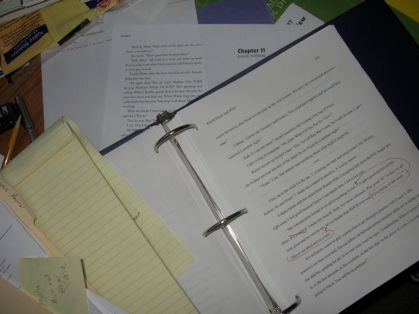
I may be weird, but I love revision. I feel like I’m sculpting. All of the clay is there and I’m just molding it, cutting some here, adding some there, trying to get it perfect. To make it look exactly like what I want it to look like. Because I like to write by scenes, which often become chapters, I like to write an opening that invites the reader in, action in the middle, and a piece at the end that makes them want to read on. Most of my revision process feels like smoothing the story, making sure one thing flows into the other. Then it becomes trying to hit the perfect word, phrase, and that sort of polish.
Why do you write about Sports?
All of my books so far have a main character that plays sports. I guess because I played a lot of sports and have some understanding of what goes on there. Plus, sports are a place where there is a lot of action and interaction. The situations that develop force people to make choices and often in the heat of the game or play, reveal their true personalities. I find that a very interesting context for stories.
Where did the idea for REBOUND come from?
REBOUND came from a conversation I had with some high school students. We were at a school district strategic planning meeting and were having breakfast together. As we chatted about school I was quickly surprised that their descriptions of race relations were very similar to my experiences twenty years earlier. I went home that day and wrote out the first scene of the story. Two of the main characters were in that scene and the subtle interplay about race was in it. Funny though, that scene, which set the tone of the book and started things up for me, eventually had to be cut.
Final advice?
Persevere. Stick with it.
It takes time to write a good story or book.